Bible Note Taker & Recorder
- 4.6
- Rating
- 500.00K
- Installs
- Free
- Price

 Analysis by App-foxy
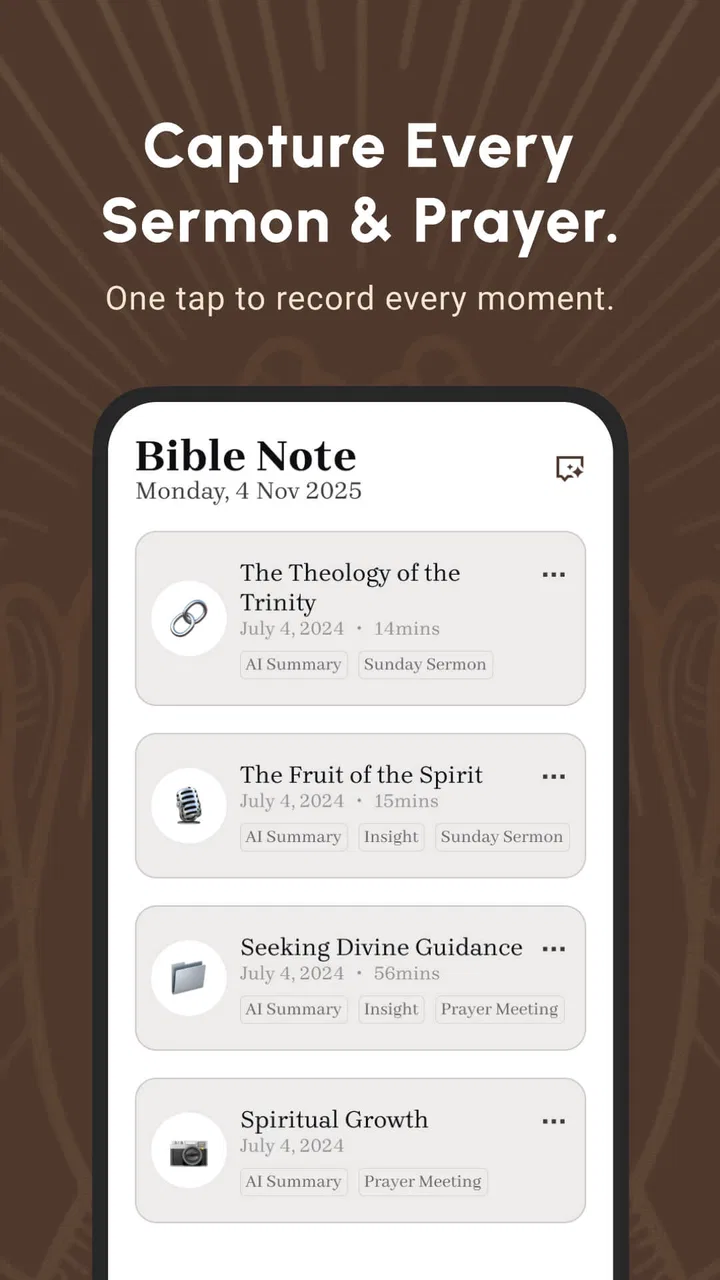
I spent time with Bible Note Taker & Recorder as a practical study companion rather than treating it like a simple voice recorder. Its purpose is clear: capture a sermon, turn spoken words into text, and use AI-generated summaries and flashcards to make later Bible study easier. That combination makes it more interesting than a conventional notes app, but it also means the quality of the experience depends on more than just pressing a record button.
Developed by Note AI Pte. Ltd., this free Books & Reference app is aimed at people who want to revisit teaching without relying entirely on memory or hurried handwriting. I can see the appeal immediately for churchgoers, small-group members, students, and anyone who likes to reflect on a sermon during the week. It is rated for Everyone, runs on Android 7.0 and later, and has reached over 100 thousand installs. Those details make it accessible to a broad range of phones, including older devices.
The app currently sits at version 1.4.2 and has a 4.4 average from around 244 ratings, with 26 written reviews. I would not treat those figures as a substitute for personal testing, but they do suggest that the central idea is connecting with users. My own view is that the app is most useful when I approach it as a first draft of my study material: it helps me collect and organize the substance of a message, while I still need to check the text, think carefully, and add my own interpretation.
You May Also Like

 Blood Strike: 2.5 Anniversary
Blood Strike’s Loadouts Turn Every Drop Into a Tactical Gamble
A close look at Blood Strike’s custom loadouts: how fast access to signature weapons reshapes its battle royale rhythm, rewards preparation, and narrows the gap between fights.

 Pandora - Music & Podcasts
Pandora’s Music Is Easy to Start, but Harder to Recover
Pandora’s strength is its low-effort path from a seed to a station. Its weak spot is how much confidence it asks you to place in connection, setup, and quiet recovery.

 8 Ball Pool
 Is Built on Rivalries, Rematches, and Routine
A close look at the rivalries, rematches, shared routines, and unanswered safety questions that turn a quick pool match into a persistent mobile community.

 Samsung Music
’s Quiet Strength Is Playing What You Already Own
Its reach comes less from spectacle than from dependable access to a personal library. That simplicity is both the app’s strongest retention engine and its ceiling.

 AccuWeather: Weather Radar
AccuWeather Review: A Quick, Clear Forecast for Everyday Decisions
For everyday plans, the best forecast is the one you can understand quickly. AccuWeather makes rain timing, radar, and local conditions easy to act on, with a few trade-offs.

 Hill Climb Racing
Why Hill Climb Racing Still Turns Crashes Into One More Run
A tiny car, a bumpy hill and one more upgrade: Hill Climb Racing keeps resurfacing because its simple chaos makes every near-miss feel personal.
More From Our News Desk



How connectivity changes the recording and study workflow
I find connectivity matters most at the handoff from a saved sermon to material I can actually study. A useful habit is to decide in advance when I’ll process a recording, rather than trying to manage transcription and review while I’m still in the church or on the way home. That small bit of planning makes it easier to give the transcript and generated study aids the attention they need.
The recording moment is only the beginning
A sermon often happens in a difficult recording environment. There may be music, several speakers, a large room, people moving nearby, or a microphone positioned far from the phone. In that situation, the value of a recording app is not simply whether it starts capturing sound. The more important question is what happens after the service, when I want to turn that recording into something I can search, review, and remember.
Bible Note Taker & Recorder is built around that second stage. The recording becomes a source for transcription, and the resulting text can support AI summaries and flashcards. That creates a more deliberate workflow than writing a few keywords in a paper notebook. I can focus on listening during the message, then return later to identify the main argument, memorable passages, and questions that deserve further study.
Connectivity matters because transcription and AI processing are not the same as saving a local voice memo. Whenever a task involves converting speech into text or generating study material, I pay attention to the point at which the app needs to process information. A strong connection can make the handoff feel natural; a weak connection can turn a quick review into a waiting period. I would therefore avoid judging the app solely by the recording screen. Its real usefulness appears in the complete path from spoken message to usable notes.
Why the network can affect the best time to process a sermon
My practical advice is to separate capture from processing. During a service, I would prioritize a stable recording and avoid doing anything that could interrupt attention. Afterward, I would process the material when the phone has a reliable connection and enough battery. This is especially sensible for a long sermon, because transcription and summary generation may require more work than a short personal memo.
This approach also changes how I plan my week. If I want flashcards ready for a small-group discussion, I would not wait until the last minute after arriving at the meeting. I would prepare the recording and review the generated material earlier, while there is time to correct wording and decide which questions are genuinely useful. The app can accelerate preparation, but it does not remove the need for preparation.
That distinction is important. AI-generated notes can make a message easier to revisit, yet a summary may flatten a nuanced explanation or miss the significance of a particular verse. I would use the summary as a map, not as a replacement for the original recording, a Bible, or the speaker’s full context. The strongest workflow is to move between the transcript, the summary, and the source material instead of trusting one output blindly.
Mobile use is convenient, but the setting still matters
The phone format suits the way many people attend church. I can imagine placing the device beside a notebook, starting a recording, and leaving it alone while listening. Later, the same phone becomes a review tool during a commute, a lunch break, or a quiet moment at home. That continuity is one of the app’s strongest ideas: the sermon does not have to remain locked in the time and place where I first heard it.
There is also a useful difference between recording in a church building and recording a personal reflection afterward. A sermon may contain room noise and changing voices, while a short follow-up note spoken in a quiet room is likely to be easier to transcribe. I would use that difference strategically. After a service, I could record a brief spoken reflection with the main point I want to remember, then compare it with the app’s generated material. That creates a personal layer that an automatic summary cannot provide on its own.
For commuters, the app may be more valuable as a review aid than as a recording tool. Listening to a full message on a crowded bus can be inconvenient, while reading a concise summary or working through flashcards may fit the situation better. In a quiet study session, however, I would go back to the transcript and recording to check details. The best format depends on where I am and how much attention I can give the material.
A realistic Sunday-to-weekday workflow
Here is how I would use it in ordinary life. On Sunday, I would begin the recording before the teaching starts and keep the phone positioned where the speaker’s voice is reasonably clear. I would not constantly interact with the screen, because touching the phone repeatedly creates distractions and increases the chance of stopping something accidentally.
After the service, I would wait until I had a dependable connection before requesting transcription or AI-based study material. Once the text is available, I would scan the opening and closing sections first. Those areas often reveal the theme and practical application, while the middle of a message may contain examples or supporting points that need more careful reading.
Next, I would compare the summary with the transcript. If a flashcard uses a phrase that sounds incomplete, I would rewrite it in my own words rather than memorizing an unclear sentence. I would also add the relevant Bible reference manually in my study notes if the generated material does not make that connection clear enough. This is one of the less obvious trade-offs: automation saves time, but editing is what turns raw output into something genuinely personal.
During the week, I would use the flashcards as prompts rather than as a test of religious knowledge. A good prompt might remind me of the message’s central question or application. A poor prompt might focus on an isolated phrase without enough context. The app can help produce the starting material, but I remain responsible for deciding whether each card supports meaningful reflection.
What happens when connectivity or processing does not go smoothly
Any workflow that moves from audio to transcription to AI output has several points where friction can appear. A recording may be clear enough to listen to but difficult for automated transcription. A connection may be unstable at the moment processing begins. A generated summary may be shorter than expected or leave out a detail that mattered to me. I would plan for these possibilities instead of assuming every sermon will become perfect notes immediately.
The safest habit is to protect the original recording until I have checked the transcript and study material. I would not treat the first generated result as the only copy of the message. If the app gives me a usable transcript, that becomes a valuable reference; if the summary is imperfect, the transcript and recording still give me a way to recover the missing context.
Recovery also means knowing when to stop trying to force an automated result. If a speaker’s voice is masked by music or crowd noise, repeatedly regenerating a summary may not solve the underlying problem. In that case, I would listen to the recording, identify the key section manually, and write a short note myself. The app is a helpful assistant, not a guarantee that every audio environment will produce clean text.
For this reason, I would test the complete process with a short recording before relying on it for an important event. A brief trial can show whether the phone placement, room acoustics, and connection are suitable. It also gives me a chance to learn where the app places its transcription and flashcard tools without trying to navigate them during a service.
Using the app without wasting mobile data
Because the app’s notable features involve audio, transcription, summaries, and flashcards, I would be thoughtful about when I process material. Recording a long sermon and then immediately sending it through every available step on mobile data may not be the most sensible routine. I would prefer to handle heavier processing when connected to a trusted network, especially if I have several recordings waiting.
This is not just about saving data. It also makes the workflow calmer. If I process everything at once in a busy place, I may be tempted to skim the result and move on. Processing later, in a quiet setting, gives me the attention needed to correct errors and decide what deserves a flashcard. Connectivity becomes part of study discipline rather than merely a technical requirement.
I would also avoid creating multiple versions of the same material without a reason. If I record the same sermon repeatedly because I am unsure whether the first attempt worked, I may end up with clutter and confusion. A short test before the service, sensible phone placement, and a quick check afterward are better than producing several uncertain recordings. Keeping the workflow simple makes the app easier to maintain over time.
Privacy and attention deserve a place in the decision
When I use a tool that handles spoken teaching and turns it into text, I think about the content being processed, not only the convenience. A sermon may include personal examples, prayer requests, or comments about people in the congregation. I would be careful about recording situations where others could reasonably expect privacy, and I would avoid treating every conversation around a service as material for transcription.
The same caution applies to attention. It is easy for a phone to become a second activity during worship: checking whether the recording is still running, reading an early transcription, or trying to organize notes while the speaker is still talking. I think the app works best when it reduces the pressure to write everything down, not when it encourages constant screen checking.
There is a useful balance here. I can let the recorder capture the message while I listen actively, then use the generated text later to revisit details. That is different from outsourcing the entire experience to automation. For me, the app’s best contribution is freeing up attention during the sermon while preserving a practical route back into the material afterward.
Where it beats ordinary alternatives, and where it does not
Compared with a standard voice recorder, this app offers a more study-focused destination for the audio. A basic recorder may preserve the sound faithfully, but it leaves me to replay everything and create notes from scratch. Bible Note Taker & Recorder adds transcription, summaries, and flashcards to the same general task, which can shorten the distance between hearing a sermon and reviewing it.
Compared with a regular notes app, it is better suited to spoken content. Typing during a sermon is slower and can pull my attention away from the speaker. A paper notebook remains excellent for marking a verse, drawing a connection, or writing a personal question, but it cannot automatically turn a recording into searchable study material. I would use paper or a general notes app alongside this one when I want more control over my own wording.
Compared with a dedicated Bible study app, its distinctive strength is the capture of live teaching. A Bible app may offer stronger tools for reading passages, comparing translations, or following a structured plan, while this app begins with what was said in a sermon. If my main goal is verse lookup or a long-term reading schedule, I would choose the dedicated Bible tool. If my main problem is remembering and revisiting spoken teaching, this app is the more direct fit.
The trade-off is that automation can introduce interpretation. A handwritten note is slow but intentional. A generated summary is fast but may decide what matters before I have thought it through. I would choose this app when speed and recall are priorities, and I would rely more heavily on manual notes when the message contains delicate context, detailed argument, or material I need to study with precision.
Who should use it and who should pass
I think it is a strong match for someone who regularly attends sermons and often remembers the general feeling of a message but loses the details by midweek. It is also appealing to small-group leaders who want a starting point for discussion prompts, and to learners who benefit from turning spoken ideas into review cards. The ability to move from audio to text gives those users a practical way to build a repeatable study habit.
It may be less suitable for someone who wants a completely manual, private notebook experience, or for a user whose church setting makes recording inappropriate. It is also not my first choice for people who only need a simple audio memo. In that case, the extra transcription and study steps may add complexity without solving a real problem.
I would also be cautious if my phone connection is unreliable and I need immediate results after every recording. The app’s concept is most comfortable when I can allow time for the material to move through its processing stages. If instant, local access is the deciding factor, a conventional recorder and handwritten notes may feel more predictable.
The app is free to download, while in-app purchases range from $6.99 to $69.99 per item. I would explore the basic workflow first and decide whether the AI-assisted features genuinely save me enough time before paying for anything. That is particularly important here because the value is personal: someone who reviews sermons every week may benefit more than someone who records only occasionally.
My connectivity verdict
After using it as a sermon-to-study workflow, I see Bible Note Taker & Recorder as a thoughtful tool for people who want more from an audio recording than playback. Its strongest idea is not recording alone, but the sequence that follows: spoken teaching becomes text, text becomes a summary, and selected ideas become flashcards. That sequence can make a weekly message easier to remember and discuss.
Connectivity shapes the experience at every important transition, so I would use the app with a simple routine: record without distraction, process on a dependable connection, check the transcript against the audio, and edit the study material before trusting it. That approach reduces disappointment and keeps automation in its proper role.
My recommendation is positive, with one condition: use it as a study assistant rather than an unquestioned authority. If you want to preserve sermons, reduce frantic note-taking, and create prompts for later reflection, this app offers a useful combination in a mobile format. If you only need a basic recorder, demand fully manual control, or cannot comfortably process recordings after the service, a simpler alternative may suit you better.
For my own use, the deciding strength is the bridge between listening and remembering. The app does not replace attentive listening or thoughtful Bible study, but it can make the days between services more productive. That makes it worth trying for anyone who wants their sermon notes to remain useful after Sunday ends.
FAQs for Bible Note Taker & Recorder
01What features does Bible Note Taker & Recorder offer?
Bible Note Taker & Recorder is designed for those who want to enhance their Bible study experience. It offers features like audio recording, note-taking, and scripture highlighting. You can also organize notes by book, chapter, or topic, and sync them across devices. This makes it ideal for both personal study and group discussion settings.
02Is Bible Note Taker & Recorder user-friendly for beginners?
Yes, the app is designed with an intuitive interface that is easy for beginners to navigate. It provides guided tutorials on first use, ensuring that users can quickly grasp how to record audio, take notes, and highlight scriptures. Its simplicity does not compromise its functionality, making it accessible for all users.
03Does the app require an internet connection?
While Bible Note Taker & Recorder can function offline for note-taking and recording, some features like cloud sync and scripture downloads may require an internet connection. This ensures that your notes and recordings are always backed up and accessible across multiple devices when online.
04Can I share my notes and recordings with others?
Yes, the app allows users to share their notes and recordings via email or social media platforms. This feature is particularly useful for study groups or collaborative projects, enabling users to easily distribute their insights and discussions with others, fostering a communal learning environment.
05Is Bible Note Taker & Recorder available for both Android and iOS?
Bible Note Taker & Recorder is available on both Android and iOS platforms. It can be downloaded from the Google Play Store for Android users and the Apple App Store for iOS users, ensuring a broad reach and compatibility with a wide range of devices.
Pros
- Intuitive user interface for easy navigation.
- Ability to record audio notes seamlessly.
- Customizable note organization features.
- Offline access to saved notes and recordings.
- Syncs across multiple devices smoothly.
Cons
- Limited export options for notes and audio.
- Occasional syncing delays on slow networks.
- Lacks advanced editing tools for notes.
- Ads can be intrusive in the free version.
- No dark mode for night-time reading.

Bible Note Taker & Recorder
Gallery